
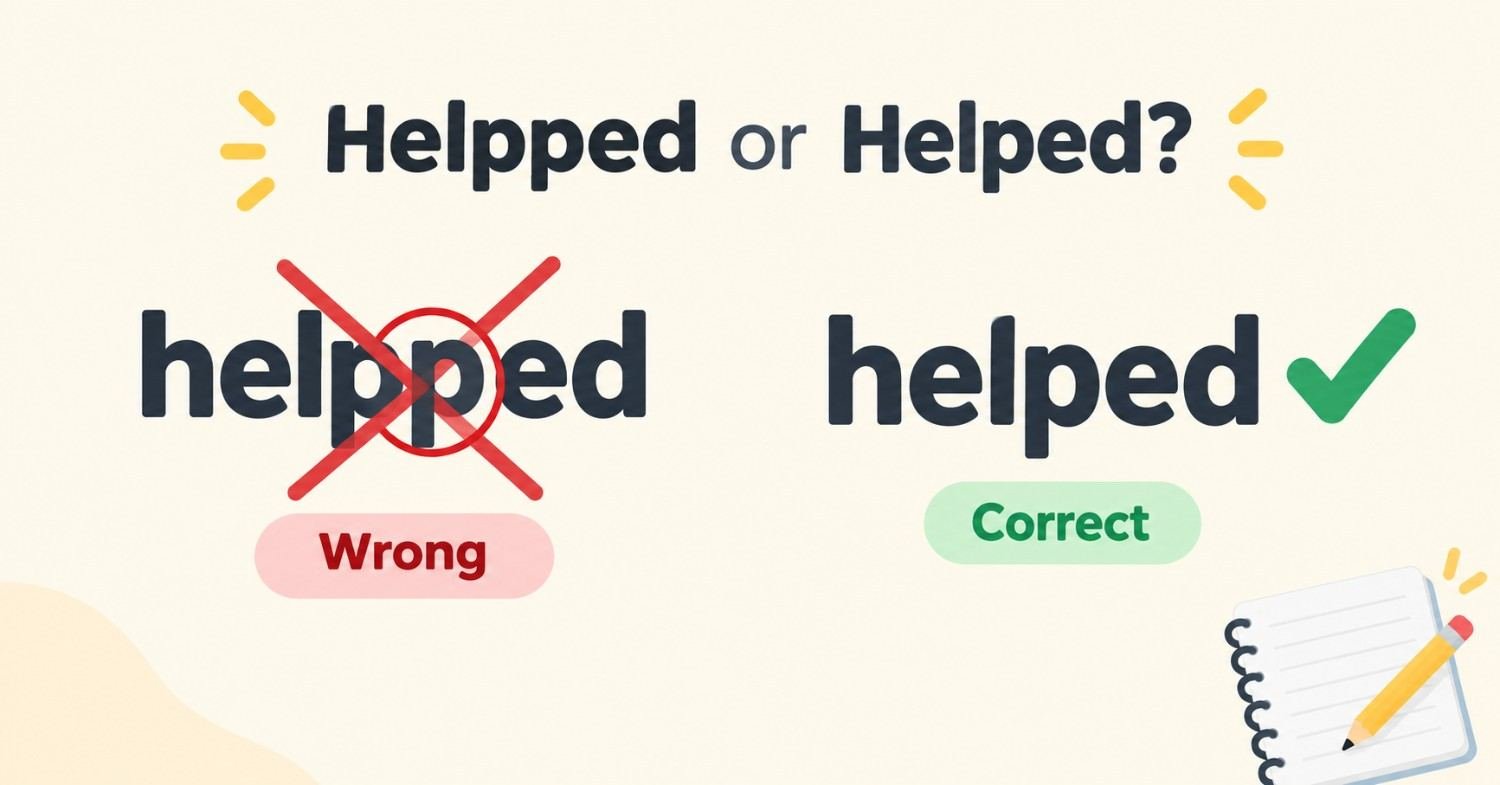
Helpped or helped? Which one do you type? Pause and picture the word for a second. Plenty of confident writers hesitate here, because that second paragraph looks like it belongs. It does not. The only correct spelling is “helped,” and “helpped” is simply an error in American and British English alike.
The slip makes sense once you notice how many everyday words double their final letter. Stopped, planned, and slipped all do it, so the brain quietly assumes help should join the club. It shouldn’t, and the reason is a tidy bit of spelling logic that takes about a minute to learn. After that, you will never second-guess yourself again, whether you are writing an email, a school essay, or a blog post.
In this guide you’ll learn the correct spelling, every form of the past tense of help, how the verb doubling rule really works, where help sits among regular verbs, and a handful of easy tricks that make the right spelling stick.
Helpped or Helped? The Short Answer
Pick Helped Every Time
Helped has one p. It works as the simple past and as the past participle, so she helped me yesterday and she has helped me for years, using exactly the same spelling. There is no sentence in modern English that calls for helpped. Not in a text message, not in a legal brief, not in a novel.
Is Helpped a Word? What the Dictionaries Say
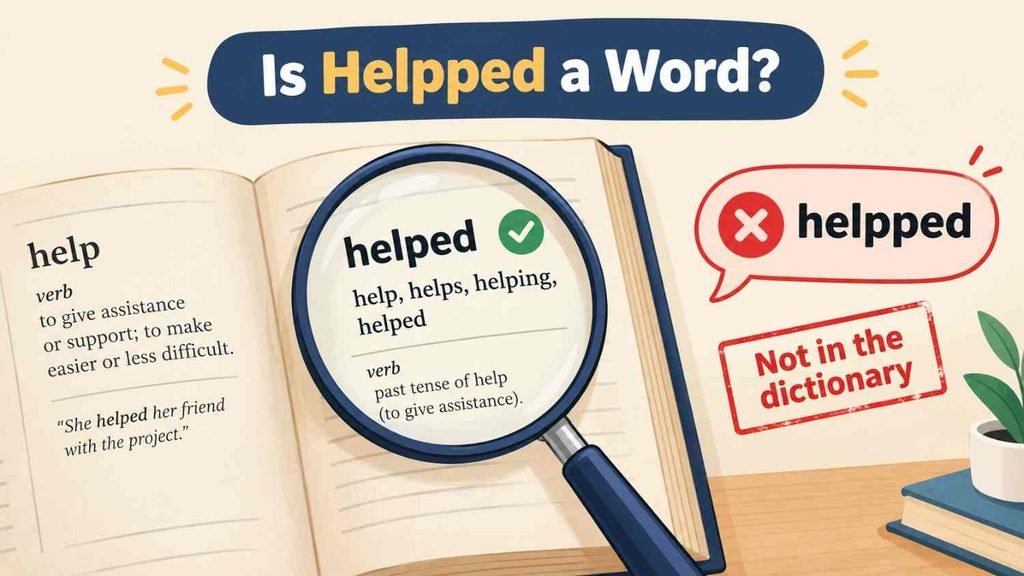
Writers often type is helpped a word into a search bar because the spelling looks half believable. Look the verb up in Merriam-Webster or the Cambridge Dictionary, and you will find help, helps, helping, and helped. Helpped never shows up. Your spellchecker underlines it in red for the same reason.
Why One Extra Letter Can Cost You Credibility
Help is among the most frequent verbs we use, so readers see it constantly and notice mistakes fast. A stray “p” on a resume, in a client email, or inside a published post sends a small but real signal of carelessness. Fixing it takes two seconds. That is a cheap trade for looking polished.
The Past Tense of Help and Its Past Participle
Good news first. This verb has no tricks. Whatever tense you need, the spelling stays the same once the ending is attached.
Simple Past Tense
The past tense of help describes something that is finished. Take the base word and add ed. My neighbor helped me carry the sofa. The new study helped researchers understand sleep patterns. Notice that nothing inside the word moves, changes, or doubles.
Past Participle and the Perfect Tenses
The past participle of help is also helped. Pair it with have, has or had and you get the perfect tenses. She has helped dozens of students. He had helped before anyone asked. By June we will have helped five hundred families. One spelling covers three different tenses, which is about as simple as English grammar gets.
Passive Voice
Passive sentences lean on the past participle too. The patient was helped by a volunteer. Hundreds of travelers were helped during the storm. Again, a single p.
Why Helped Sounds Like Helpt
Here is the sneaky reason the mistake exists. In speech, the ending after a p is pronounced as a t sound, not a d. Linguists explain this as the ed ending taking on the voicing of the consonant in front of it. So your ear hears helpt, and your brain goes hunting for a way to show that sharp stop. An extra p feels like a decent guess. Spelling does not follow the sound here, though. It follows the base word, and the base word is help.
Notice that the ing form keeps a single p as well. If you would never write helpping, you should not write helpped.
The Verb Doubling Rule and Why Help Escapes It
Most misspellings have a logical cause, and this one is no exception. The culprit is the verb doubling rule, a real and useful pattern that simply does not apply to help.
How the Verb Doubling Rule Works
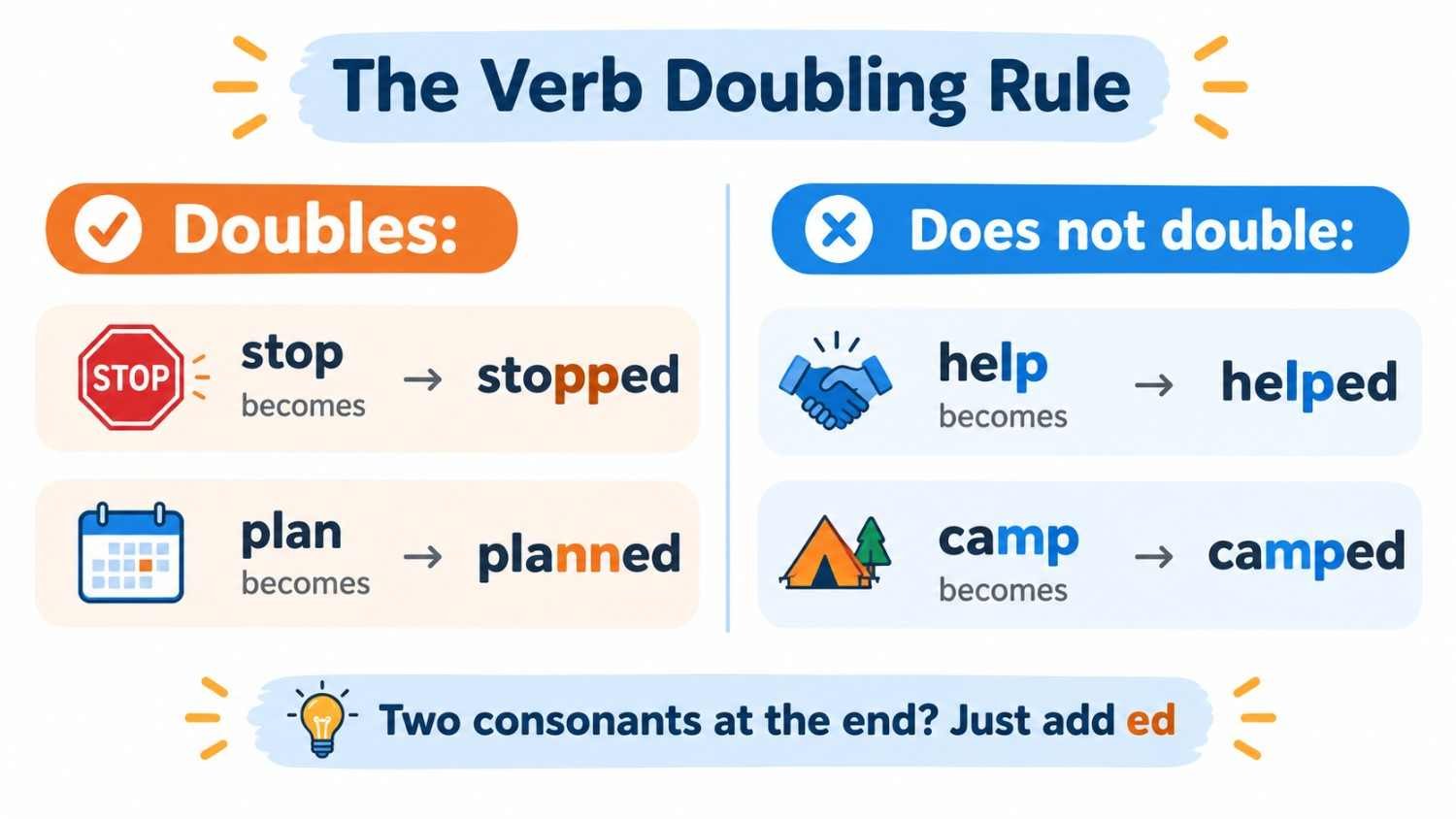
English likes to double a final consonant when a suffix that starts with a vowel arrives, such as ed or ing. The rule kicks in when two things are true. First, the word has a single syllable, or the stress falls on the last syllable. Second, it ends in one vowel followed by one consonant.
Stop becomes stopped. Plan becomes planned. Hop becomes hopped. Begin, stressed on the last syllable, becomes beginning. The extra letter protects the short vowel sound, which is why hoping and hopping mean different things. You can read more about how spelling patterns like this developed in this overview of English orthography.
Why Help Does Not Qualify
Look at the end of help. After the vowel e you find two consonants, l and p. That cluster already keeps the vowel short, so there is nothing left for a second p to do. Help fails the second condition and is left alone. The result is helped.
A Side by Side Look at Doubling
The same logic explains a whole family of words. Compare the ones that double with the ones that don’t.
| Base verb | How it ends | Past tense | Double letter? |
|---|---|---|---|
| stop | vowel and p | stopped | Yes |
| slip | vowel and p | slipped | Yes |
| plan | vowel and n | planned | Yes |
| help | vowel, l and p | helped | No |
| yelp | vowel, l and p | yelped | No |
| gulp | vowel, l and p | gulped | No |
| camp | vowel, m and p | camped | No |
| limp | vowel, m and p | limped | No |
A One Question Test You Can Use Anywhere
Before you double a letter, ask whether the word ends in exactly one vowel and one consonant. If it ends in two consonants, as help, jump and walk do, just add ed and move on. That single check settles most doubling questions in seconds.
Two Wrinkles Worth Knowing
Verbs ending in w, x or y never double, so snow and fix are safe. And British English doubles some final l endings that American English leaves single, which gives travelled in the UK and traveled in the US. Neither wrinkle touches help.
Regular Verbs, Irregular Verbs and the Odd History of Help
Help Belongs Among the Regular Verbs Today
Regular verbs build both the past tense and the past participle by adding ed. Walk, jump and talk work that way, and so does help. Irregular verbs go their own way, as in go, went, gone or write, wrote, written. A handy tell is this: when the simple past and the past participle match, you are usually dealing with one of the regular verbs. That is exactly the case here. For a fuller list of the rule breakers, see this overview of English irregular verbs.
Where Helpt and Holpen Came From
It was not always this tidy. Old English treated help as a strong verb, with healp as the past tense and a participle that became holpen. Over the centuries speakers drifted toward the ed pattern, just as they did with many other verbs. The Online Etymology Dictionary traces that path in detail.
Traces survive in older writing. The King James Bible, published in 1611, says in Psalm 86:17 that the Lord has holpen the speaker. You may also spot helpt in old printed books and some regional speech. Today both forms count as archaic.
What This History Means for Helpped
Helpt and holpen have real histories behind them. Helpped has none. It never belonged to any period of English as an accepted form. It is a modern slip born from pattern matching with stopped and slipped, and nothing more. So if anyone asks is helpped a word, you can answer with confidence that it never has been.
Helped in Real Sentences and Common Mistakes
Everyday Examples
Thanks for the tip, it really helped. If the app had helped earlier, I would have saved an hour. She was helped by a nurse the moment she arrived. Our team has helped many small businesses launch their first websites. Each sentence uses a different tense or voice, and each keeps one p.
Helped at Work and in School
On a resume you might write: Helped cut customer wait times by simplifying the intake process. In a cover letter: My volunteer work has helped me build strong relationships with community partners, and in an email: Thanks for sending the guide, it helped us fix the problem quickly. In an essay: The experiment helped confirm the original theory.
Five Mistakes to Avoid
- Writing helpped with a doubled p.
- Writing helpt because of how the word sounds.
- Writing could of helped. Could’ve sounds like could of, so the wrong version spreads. The correct phrase is could have helped.
- Using helping where the past is needed, such as she helping me yesterday instead of she helped me yesterday.
- Carrying the extra p into the ing form and writing helpping.
Help, Helps, Helping and Helped: Which One Fits?
Use help for the base form and for present tense subjects like I, you, we and they and with he, she, and it. Use helping for ongoing action and help for finished action, for perfect tenses and for passive sentences.
How to Remember the Spelling for Good
Memory Tricks That Work
Try the LP shield: the LP at the end of help already blocks any doubling, so no second P is needed and helping test: if helping has one p, helped has one p too. Try the family trick: group help with yelp, gulp, and camp, since none of them double. Or say it in two beats, help and ed, and picture it spelled that way instead of by its helpt sound.

Tools That Catch the Slip
Spellcheck in Google Docs, Microsoft Word, and most browsers flags helpped right away. For anything important, read the text aloud once before you hit send, and search the file for help as a last sweep. It takes ten seconds and saves a red face.
Teaching It to Students and Colleagues
If you coach writers or teach a class, start with the verb doubling rule instead of a list of words. Ask learners to sort verbs into doubled and not doubled piles using the table above. The logic sticks far better than rote memory, and it helps with dozens of other verbs too.
Conclusion
So, helpped or helped? Helped wins every time. Helpped is not a word, and that extra “p” comes from stretching the verb doubling rule over a verb that ends in two consonants. Once you see that, yelp, gulp, and camp stop being tricky as well.
Three takeaways to keep. First, helped is the one correct spelling for both the simple past and the past participle. Second, help is a regular verb that takes a plain ed ending because it finishes in lp, not in a single vowel and consonant. Third, helpt and holpen are old forms with a real history, while helpped has never been one of them.
Save this guide, send it to a friend who writes a lot, and browse our other grammar articles to polish every sentence you publish.
FAQ
Is helpped a word?
No. Helped is the correct past tense and past participle. Helpped is always a misspelling.
What is the past tense of help?
The past tense of help is helped. The past participle is also helped, so one spelling covers both.
Why does helped have only one p?
Help ends in two consonants, l and p, so the verb doubling rule does not apply and no extra p is added.
Are helpt and holpen still correct?
Not in modern writing. Both are old forms. Holpen appears in the King James Bible, but everyday English uses helped.
Do American and British English spell helped differently?
No. Both use helped with a single p, so one spelling suits every audience.