
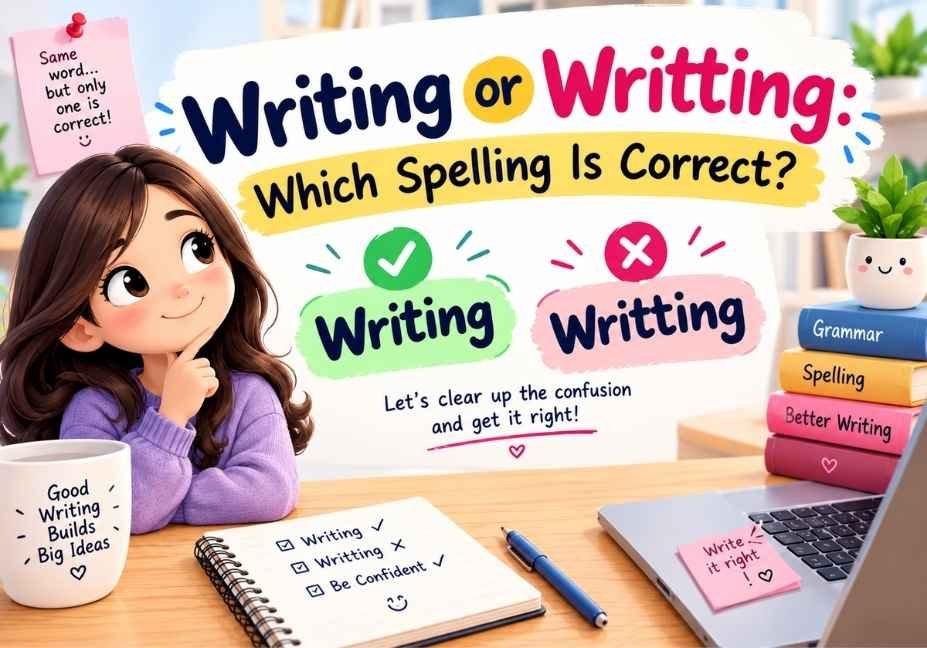
Many people type “writting” by mistake when they mean the common English word for putting thoughts into text. This mix-up happens often enough that it is worth clearing up once and for all.
If you have ever paused mid-sentence and wondered whether to use one t or two, you are not alone. This guide explains the correct spelling of writing, why writting is wrong, and how to remember the difference for good.

Quick Answer
Writing is the correct spelling. It has one t. Writting, with two t’s, is a spelling error and does not appear in standard English dictionaries, since using it with two t’s is never accurate. freelancewritingjobs
Writing vs Writting at a Glance
| Spelling | Status | Example sentence | How to tell it’s right |
| Writing | Correct | She enjoys writing short stories on weekends. | Matches every major dictionary entry |
| Writting | Incorrect | He is writting a letter. | Extra t is a common typing slip |
| Write | Correct (base verb) | I will write to you tomorrow. | Root word, no -ing ending |
| Written | Correct (past participle) | The report has been written already. | Used after “has,” “have,” or “had” |
Why “Writing” Is Spelled With One T
The confusion usually comes from a real spelling rule in English, just applied to the wrong word. For many short verbs, you double the final consonant before adding -ing. Think of “sit” becoming “sitting” or “run” becoming “running.”
That rule applies when the verb ends in a single consonant right after a single stressed vowel. “Write,” however, does not fit that pattern. It ends in a silent e, not a bare consonant. The standard rule for words like this is simple: drop the silent e and add -ing. So “write” becomes “writing,” not “writting.”
This is the same pattern you see in other common words. “Ride” becomes “riding.” “Smile” becomes “smiling.” “Hope” becomes “hoping.” None of these double the consonant because the silent e is dropped first.
Why the Mistake Is So Common
People often misspell writing as writting for a few understandable reasons.
Rule confusion. The doubling rule for short, closed-syllable words like “sit” and “run” is easy to overapply. Writers sometimes assume every one-syllable verb doubles its final consonant before -ing, which leads to writting instead of writing.
Fast typing. Double letters are an easy typo, especially on mobile keyboards where autocorrect does not always catch the error.
Visual pattern matching. Since so many -ing words in English do have double consonants, writting can look right at a glance even though it is not.

Other Forms of the Word
Once you have the base spelling down, the related forms follow the same drop-the-e pattern.
- Write – the base verb, as in “I write every morning.”
- Writes – third person singular, as in “She writes for a magazine.”
- Wrote – simple past tense, as in “He wrote the email last night.”
- Written – past participle, as in “The contract was written by a lawyer.”
- Writer – the person who writes, as in “She is a published writer.”
None of these forms ever take a double t. If you see “writting,” “writter,” or “writted” anywhere, treat them as spelling errors.
Common Misspellings to Watch For
Besides writting, a few related errors show up often in casual writing and messaging.
- Writeing – adds an extra e that does not belong once the silent e is dropped
- Riting – drops the w, which changes the word entirely
- Writting – the most frequent error, with a doubled t
A quick way to catch these mistakes is to sound out the base verb first. If the word ends in a silent e, like “write,” “ride,” or “hope,” drop the e before adding -ing. If it ends in a short vowel plus a single consonant, like “sit” or “run,” double the consonant instead.
How to Remember the Correct Spelling
A simple trick helps most people lock in the spelling. Picture the word “write” with its silent e crossed out, then “ing” slotted in right where the e used to sit: w-r-i-t-(e)-ing becomes writing. Practicing this swap a few times usually makes the correct spelling stick.
Spell checkers and grammar tools will also flag writting automatically, so proofreading before you send an email or publish a post is a reliable backup.

Final Takeaway
Writing is the correct spelling, and writting is simply a common typo rooted in a spelling rule applied to the wrong word. Remember that write ends in a silent e, which gets dropped before adding -ing, to avoid the mistake going forward.
FAQ’s
Is writting ever an acceptable spelling?
No. Writting is not recognized in standard English dictionaries or style guides. Writing is the only correct spelling.
Why does writing use one t instead of two?
Because “write” ends in a silent e. English spelling rules call for dropping that e and adding -ing, not doubling the final consonant.
Is writeing also wrong?
Yes. Writeing incorrectly keeps the silent e before adding -ing. The correct form drops the e entirely.
Does autocorrect usually catch writing?
Most modern spell checkers and keyboards flag writing as an error, though it can still slip through in fast typing or informal messages.
What is the correct past tense of write?
The simple past tense is “wrote,” as in “I wrote a letter yesterday.” The past participle is “written,” used with helping verbs like “has” or “have.”