
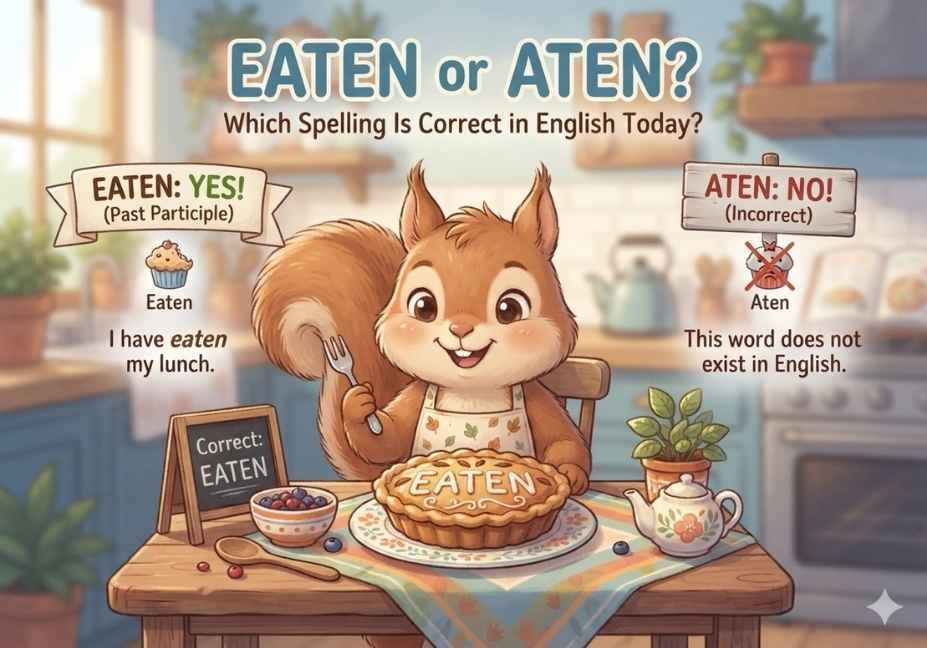
Eaten or aten can look like two possible spellings when you hear the word spoken quickly. In standard English, however, eaten is the correct past participle of the verb eat. The spelling aten is not the standard English verb form.
The confusion becomes easier to solve when you compare eat, ate, and eaten. Each form has a different job in a sentence. This guide explains when to use each one, why “I have eaten” is correct, and why “I have ate” is not.
Quick Answer: Eaten or Aten?
Eaten is the correct spelling when you need the past participle of eat. “Aten” is not the standard spelling of this verb form.
The basic pattern is:
Eat → Ate → Eaten
For example:
“ I eat breakfast every day.”
“I ate breakfast this morning.”
“I have eaten breakfast already.”
Oxford Learner’s Dictionaries lists ate as the past simple form and eaten as the past participle form of eat.
Eaten or Aten at a Glance
| Word | Correct standard English use | Example | Grammar role |
| eat | Present or base form | I eat fruit daily. | Base verb |
| ate | Simple past | I ate lunch early. | Past tense |
| eaten | Past participle | I have eaten lunch. | Past participle |
| aten | Not the standard verb spelling | I have aten lunch. | Incorrect in standard English |
The form eaten is also confirmed by the Cambridge Dictionary as the past participle of eat.
Why Eaten Is Correct, and Aten Is Not
The main reason is that eat is an irregular verb. It does not form its past by simply adding an ending such as “ed.”
Instead, its common forms change:
eat for the base form
ate for the simple past
eaten for the past participle
This pattern is similar to other irregular verbs.
For example:
go → went → gone
see → saw → seen
write → wrote → written
eat → ate → eaten
So when you need the third form of eat, the standard spelling is eaten, not aten.
Cambridge Dictionary directly defines eaten as the past participle of eat.
What Does Eaten Mean?
Eaten means that the action of eating has been completed or is being described in a grammatical structure that requires a past participle.
Consider these examples:
“I have eaten breakfast.”
“She has eaten the last piece of cake.”
“They had eaten before we arrived.”
“The food was eaten quickly.”
In each example, eaten is doing the job of a past participle.
Dictionary.com and Collins also identify eaten as the past participle of eat.
What Does Ate Mean?
Ate is the simple past form of eat. You generally use it when describing an action that happened in the past.
Examples include:
“I ate breakfast at 8.”
“She ate the whole sandwich.”
“We ate dinner together.”
“They ate pizza last night.”
Notice that ate can work as the main verb without have, has, or had.
That is the key difference between ate and eaten.
When Should You Use Eaten?
Use eaten when the grammar of the sentence calls for a past participle.
A common pattern is:
have + eaten
has + eaten
had + eaten
For example:
“I have eaten already.”
“She has eaten lunch.”
“They had eaten before the movie started.”
The helping verb carries the tense structure, while eaten supplies the past participle.
Present Perfect
Use have eaten or has eaten when talking about a completed action connected to the present.
Examples:
“I have eaten.”
“She has eaten breakfast.”
“We have eaten at that restaurant before.”
Past Perfect
Use had eaten when one past action happened before another past event.
Example:
“We had eaten before the guests arrived.”
“She had eaten dinner before the meeting started.”
Passive Constructions
Eaten can also appear in passive sentences.
Examples:
“The cake was eaten by the children.”
“All the cookies were eaten.”
“The food has been eaten.”
In these sentences, eaten is still the past participle.
When Should You Use Ate?
Use ate for a completed event in the simple past.
Examples:
“I ate an apple.”
“He ate lunch at noon.”
“We ate at home.”
“She ate too much cake.”
You can often identify this structure because the sentence simply tells you what happened in the past.
For example:
“I ate breakfast this morning.”
The verb ate already shows that the action happened in the past.
Eaten or Ate: What Is the Main Difference?
The easiest way to understand the difference is to look at the structure around the verb.
Ate is simple past.
Eaten is the past participle.
Compare these sentences:
“I ate breakfast.”
“I have eaten breakfast.”
Both sentences describe eating in the past, but the grammar is different.
In the first sentence, ate is the simple past verb.
In the second, have is the helping verb and eaten is the past participle.
This is why you should not automatically replace one with the other.
Is “I Have Ate” Correct?
No. In standard English, “I have ate” is incorrect.
The correct sentence is:
“I have eaten.”
This happens because have must be followed by the past participle in this structure.
So:
“I have eaten lunch.” ✅
“I have ate lunch.” ❌
“She has eaten already.” ✅
“She has ate already.” ❌
“They had eaten before us.” ✅
“They had ate before us.” ❌
Remember the simple pattern:
Have + eaten
Has + eaten
Had + eaten
Is “I Ate” Correct?
Yes. “I ate” is completely correct when you are using the simple past.
Examples:
“I ate breakfast.”
“I ate the sandwich.”
“I ate too much.”
“We ate at a restaurant.”
There is no need to add have, has, or had before ate when using the simple past.
Is “I Eaten” Correct?
Not by itself in standard sentence structure.
For example:
“I eaten breakfast.” ❌
The sentence needs a helping verb:
“I have eaten breakfast.” ✅
“She has eaten breakfast.” ✅
“They had eaten breakfast.” ✅
This is one of the easiest ways to identify whether eaten is being used correctly.
What About “Did You Ate?”
This is another common mistake.
The standard form is:
“Did you eat?”
Not:
“Did you ate?”
Why? Because did already marks the sentence as past tense. The main verb returns to its base form.
Compare:
“I ate breakfast.”
“Did you eat breakfast?”
“I did not eat breakfast.”
The same idea applies to negatives:
“I did not eat the cake.” ✅
“I did not ate the cake.” ❌
So there are three useful structures to remember:
I ate.
I have eaten.
Did you eat?
Common Mistakes With Eat, Ate and Eaten
These errors are easy to make because the three forms look and sound quite different.
Mistake 1: Using Aten Instead of Eaten
Incorrect:
“I have aten already.”
Correct:
“I have eaten already.”
The word aten is not the standard English past participle of eat.
Mistake 2: Using Ate After Have
Incorrect:
“I have ate lunch.”
Correct:
“I have eaten lunch.”
The helping verb have requires the past participle eaten.
Mistake 3: Using Eaten Without a Helping Verb
Incorrect:
“I eaten breakfast.”
Correct:
“I ate breakfast.”
Or:
“I have eaten breakfast.”
Choose the form based on the sentence structure.
Mistake 4: Using Ate After Did
Incorrect:
“Did she ate the cake?”
Correct:
“Did she eat the cake?”
After did, use the base form eat.
Easy Examples to Remember
These examples show the difference clearly:
Present
“I eat breakfast at seven.”
Simple past
“I ate breakfast at seven.”
Present perfect
“I have eaten breakfast.”
Past perfect
“I had eaten breakfast before work.”
Past question
“Did you eat breakfast?”
Seeing the forms together makes the pattern much easier to remember.
Can “Aten” Ever Be a Real Word?
There is an important detail here.
As a lowercase English verb form, aten is not the standard spelling you should use instead of eaten. However, Aten with a capital letter is a proper noun connected with ancient Egyptian religion. The British Museum describes Aten as a solar god represented as a sun disc, especially associated with the reign of Akhenaten.
Dictionary.com also lists Aten as the solar disc worshipped as the sole god during Akhenaten’s reign.
So these are different:
eaten = past participle of eat
Aten = name associated with an ancient Egyptian solar deity
They are not two spellings of the same English verb.
There is also a Wiktionary entry for lowercase aten that labels it a nonstandard past participle of eat. That does not make it the standard spelling for normal English writing.
How Do You Remember Eaten?
A simple memory trick is to memorize all three main forms together:
Eat → Ate → Eaten
Think of them as a set rather than trying to remember eaten by itself.
For example:
“I eat now.”
“I ate yesterday.”
“I have eaten already.”
You can also remember the helping verb rule:
Have, has, or had → eaten
Simple past without a helper → ate
Did → eat
This quick test can solve most situations.
Eaten or Aten in Text Messages
The same standard spelling applies to texting.
You might see:
“Have you eaten?”
“I’ve eaten already.”
“I ate a little earlier.”
“I haven’t eaten yet.”
Typing aten instead of eaten may still communicate your meaning in casual conversation, but it is considered a spelling mistake in standard English.
Texting often includes shortcuts and informal spelling, but that does not change the standard grammar rule.
Why Do People Confuse Eaten and Aten?
The confusion often comes from pronunciation.
In everyday speech, eaten can sound short, especially when spoken quickly. This can make learners think the word starts directly with an “at” sound.
However, pronunciation does not change the standard spelling.
When writing, remember that the correct form contains the e:
eaten
Not:
aten
Reading the word in complete sentences can also help make the correct spelling feel natural.
Eaten or Ate in Questions
Questions are another place where these forms can become confusing.
Use did + eat for simple past questions:
“Did you eat lunch?”
“Did she eat the cake?”
“Did they eat before leaving?”
Use have or has + eaten for present perfect questions:
“Have you eaten?”
“Has she eaten?”
“Have they eaten yet?”
For past perfect:
“Had they eaten before you arrived?”
The helping verb tells you which verb form you need.
Eaten or Ate in Negative Sentences
Negative sentences follow the same basic rules.
With did, use eat:
“I did not eat breakfast.”
“She did not eat lunch.”
With have, has, or had, use eaten:
“I have not eaten.”
“She has not eaten.”
“They had not eaten.”
Avoid these forms:
“I did not ate.” ❌
“I have not ate.” ❌
“I have not eaten.” ✅
A Simple Grammar Test
When you are unsure about eaten or eaten, first ask what form of the verb the sentence requires.
If you see have, has, or had, use eaten.
If you are describing a completed action in the simple past, use ate.
If you see did, use eat.
For example:
“Have you ___?” → eaten
“She ___ yesterday.” → ate
“Did you ___?” → eat
This three-step check works in many everyday sentences.
Conclusion
When choosing between eaten and aten, use eaten for the standard English past participle of eat. The full verb pattern is simple: eat, ate, eaten.
Use ate for the simple past, eaten after helping verbs such as have, has, and had, and eat after did. Once you remember this pattern, the difference becomes much easier to use correctly.
FAQ’s
Is “aten” correct spelling?
No. Eaten is the standard English past participle of eat. “Aten” is not the standard verb spelling.
Is it “I ate” or “I eaten”?
Use “I ate” for simple past. Use “I have eaten” when the sentence requires a past participle.
Is “I have ate” grammatically correct?
No. The correct form is “I have eaten.”
What is the past tense of eat?
The simple past is ate. The past participle is eaten.
Can Aten be a real word?
Yes, Aten can be a proper noun referring to an ancient Egyptian solar deity. It is unrelated to the standard verb form eaten.