

Maybe you saw the name in a search result. Maybe a friend dropped it into a chat. Either way, you’re now wondering what it actually is. This PushWiki explained guide starts with the short answer and then fills in the rest. You’ll see what the site offers and who gets real value from it. You’ll also find out where it comes up short.
One thing first. PushWiki isn’t slang. Nobody is texting it to you as a secret code. It’s the name of a website. The word “wiki” makes most folks picture a giant encyclopedia that anyone can edit, and that picture doesn’t quite fit here. Stick around and you’ll learn what PushWiki is and how it stacks up against Wikipedia. You’ll also learn how to read it without getting fooled.
What Is PushWiki?
PushWiki usually means PushWiki.com. It’s a free information website that publishes short guides in plain English. The topics lean toward technology and AI tools and business and everyday how-to help. The name says “wiki,” but the site behaves more like a blog or small online magazine. You can read it without signing up. Details about who runs it are hard to find. So use it as a starting point and not as the last word.
What Does PushWiki Mean?
Search results for this term are a bit of a mess. The name points to more than one thing. Most people want the website. A smaller group wants something older and far more technical. This table sorts the pushwiki.com meaning out in one glance.
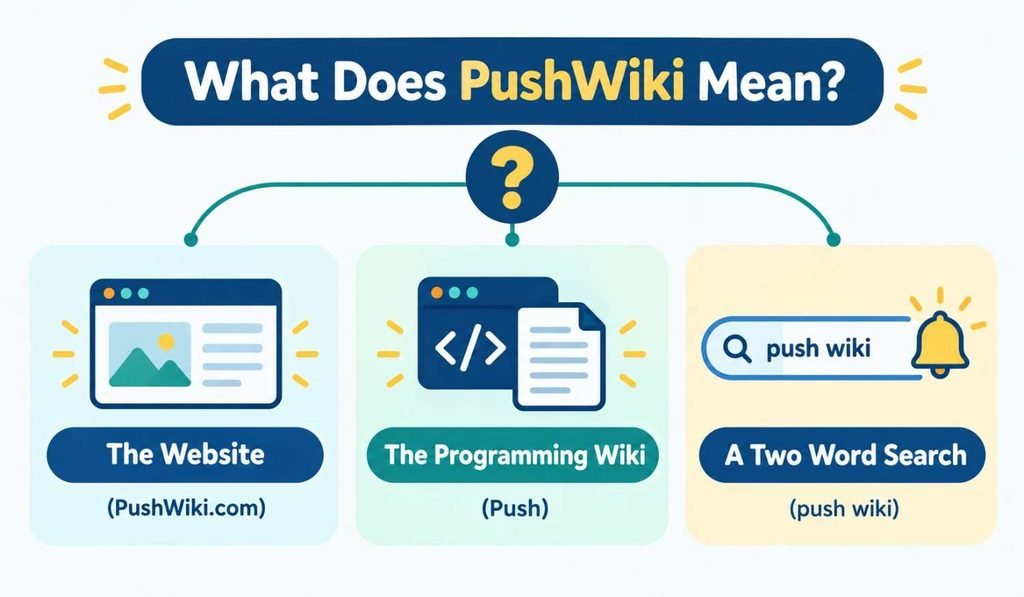
| Meaning | Where you see it | What it refers to | Who cares most? |
|---|---|---|---|
| PushWiki.com | Search results and shared articles | A free information website with guides and explainers | General readers |
| Push Wiki (programming) | Developer mailing lists and research pages | A documentation wiki for the Push programming language | Programmers |
| “Push wiki” as two words | Casual searches | Any reference page about push topics such as notifications | Mixed audience |
PushWiki as a Website
This is the meaning almost everyone is after. PushWiki.com is an information site packed with explainers and guides. A write-up on About Chromebooks calls it a WordPress publishing site. That review says it covers technology and AI tools along with business and productivity topics. It also warns that more than one domain uses the PushWiki label. The live tech and AI version sits on a hyphenated address, so check what you type.
Other reviewers see it differently. A piece on Editorialge frames the site as a simple place to learn about websites and online tools. Another on Startup Rise says it wants knowledge to feel easy for students and professionals and casual learners. The descriptions don’t line up perfectly. That’s actually a clue. The site covers a lot of ground, and each writer zooms in on a different corner.
The Older Push Wiki for Programmers
Now for the second meaning. It has nothing to do with the website. Back in June 2010 a developer named Thomas Helmuth posted a note on the Push mailing list. He said he’d started a documentation wiki for Push projects on Wikia. The idea was to keep track of the docs and the differences between versions. Anyone working on Push could edit the pages.
He was upfront about the flaws too. The free host showed ads, and nobody on the team controlled it. So he asked the community for better ideas. If you came from a developer forum, this Push Wiki programming project is likely what you were hunting for. It has no link to PushWiki.com.
Why the Name Causes Mix-Ups
Some of the confusion comes from the word itself. Wikipedia explains that “wiki” comes from a Hawaiian word meaning “quick.” Ward Cunningham built the first wiki in 1995. Since then the term has come to mean a site where lots of people edit pages together.
PushWiki.com doesn’t seem to work that way. It borrows the feel of a wiki and skips the open editing. Then there are people who type “push wiki” as two words because they want pages about push notifications. That piles even more noise onto the results page. So take five seconds and confirm the exact address before you trust anything you read.
What Does PushWiki Cover?
The range is wide. Reviewers agree on that much even when they argue about the details. These are the topics that pop up most in PushWiki articles.
- Technology explainers about apps and devices and online tools
- AI tools and how people use them
- Business and productivity tips for small teams
- General how-to guides for everyday problems
- Reference style pages that define terms in plain words
- Website and SEO basics for bloggers and writers
That’s a typical spread for a general information site. It isn’t a deep niche resource. Don’t expect the depth of a medical journal or a software manual. You’ll get short pieces that tackle one question at a time.
One profile says the editors begin with the reader’s question and build each page around it. Plenty of modern content teams do the same. The answer comes first, and the jargon stays low. A beginner can save real time that way. An expert may find it a little thin.
How PushWiki Works
Using it is easy. Open a browser. Search or browse by topic. Read. Reviews say it’s free and that you don’t need an account.
Adding content is another matter. The Editorialge review says readers can’t post anything without special access. That’s the biggest gap between PushWiki and a true wiki. A real wiki hands you an edit button. This site feels more like a magazine where editors decide what goes live.
Reviewers describe the pages as short and clear. You tend to get a quick intro and some headings and a summary. Speed is the whole point. A few minutes is enough to grasp the basics of a topic.
There’s a trade-off here. A small team can keep the tone steady and the pages tidy. But fewer people are looking at each claim. If a page has a mistake, it might sit there for a while before anyone spots it. Keep that in the back of your mind as you scroll.
Is PushWiki a Real Wiki?
Short answer. No, not in the classic sense. Wikipedia defines a wiki as a site where users build and edit content together. Wikipedia itself is the best known example. Based on the reviews, I found PushWiki.com doesn’t offer open editing. It publishes articles. That puts it closer to a blog or digital magazine.
This isn’t a flaw on its own. Lots of useful sites aren’t wikis. The trouble starts when expectations are off. A wiki gets checked by many people over time. A site run by a small team gets checked by that team. The PushWiki vs. Wikipedia table below shows the gap.
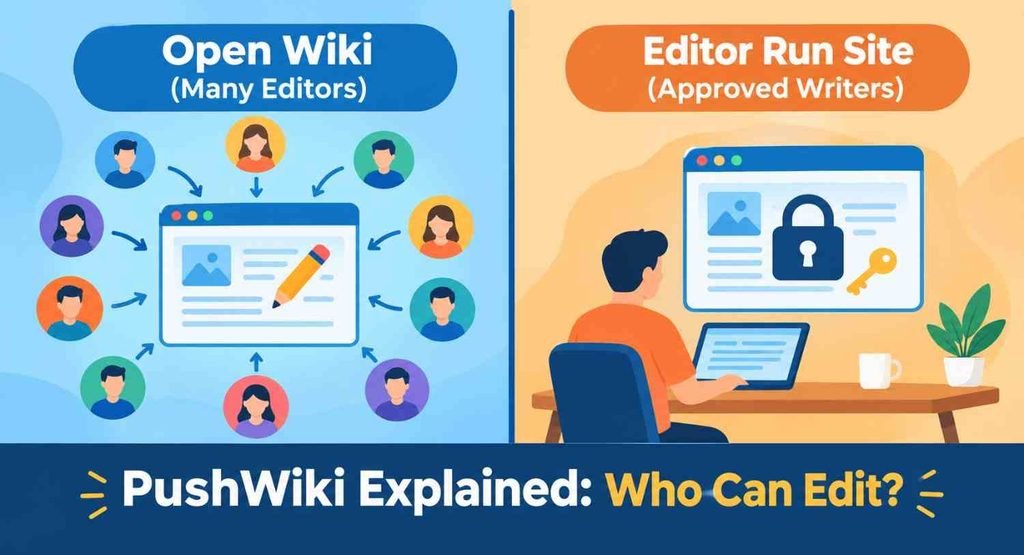
| Feature | PushWiki.com | Wikipedia |
|---|---|---|
| Who can edit? | Approved staff or writers based on reviews | Almost anyone |
| Cost to read | Free | Free |
| Account needed to read | No | No |
| Writing style | Short plain English explainers | Detailed encyclopedic entries |
| Source citations | Vary by page. | A core rule for most claims |
| Best use | A quick first look at a topic | Background research and finding sources |
Neither column wins every row. They do different jobs. PushWiki is a fast on-ramp. Wikipedia is a deeper map with a trail of references you can follow.
Is PushWiki Safe and Legit?
Safety and legitimacy aren’t the same question. Let’s take them one at a time. Think of this part as a mini PushWiki review.
Is It Safe to Browse?
The About Chromebooks review concludes that PushWiki.com is legitimate and free and safe to browse. Other write-ups point the same way. If you’re wondering if PushWiki is safe, that’s encouraging. Still use your usual street smarts. Never type a password or card number into a site you barely know. Look for https in the address bar. And watch the domain. Since several domains share the name, a lookalike is possible.
Is the Information Reliable?
Safe to open doesn’t mean right on every point. Public info about the owners and writers is limited. Google’s Search Central guidance says helpful content shows experience and expertise and trust. When a site doesn’t clearly name its authors, those signals are harder to judge. So if you ask if PushWiki is legit, the honest answer is yes for browsing and maybe for accuracy.
That doesn’t mean the content is bad. It means you should do a little homework. Treat any single article as a starting point. Compare the key facts against an official or primary source before you act. This matters most for health and money and legal topics. For a simple tech explainer the risk is much smaller.
PushWiki Strengths and Weak Spots
Strengths
- Plain English that beginners can follow
- Free to read with no sign-up
- Short pages that answer one question fast
- A wide range of everyday and tech topics
These perks are real. Plenty of people don’t want a 10,000-word guide. They want the main idea in five minutes. A site that delivers that has a clear job. It also helps readers who feel lost in technical talk.
Weak Spots
- Limited public detail about owners and writers
- Several domains share the PushWiki name
- No open editing despite the wiki label
- Depth varies, and some pages may stay surface level
- Not a replacement for expert or official advice
The name is the trickiest weak spot. Someone who expects a wiki might trust the site the way they trust Wikipedia. That would be a mistake. The two work in different ways.
Who Should Use PushWiki?
It suits some readers better than others. These groups get the most out of it.
- Students who need a quick overview before deeper research
- Bloggers and writers looking for topic ideas
- Small business owners learning new tech terms
- Casual readers who want answers without jargon
It’s a weaker fit when the stakes are high. A nurse checking a dose shouldn’t lean on it. A lawyer checking a statute shouldn’t either. A student writing a research paper needs primary sources and not a general information site.
Picture it as a friendly guide at the front door. It can point you the right way. It shouldn’t be your last stop.
How to Get the Most From PushWiki
A few small habits turn a light read into a reliable one. Try these steps.
- Start with a topic you know little about
- Read the intro and headings before the full page
- Note the key claim you plan to rely on
- Check that claim against an official or primary source
- Look at the date and see if the page is current
- Save the pages that proved accurate for later
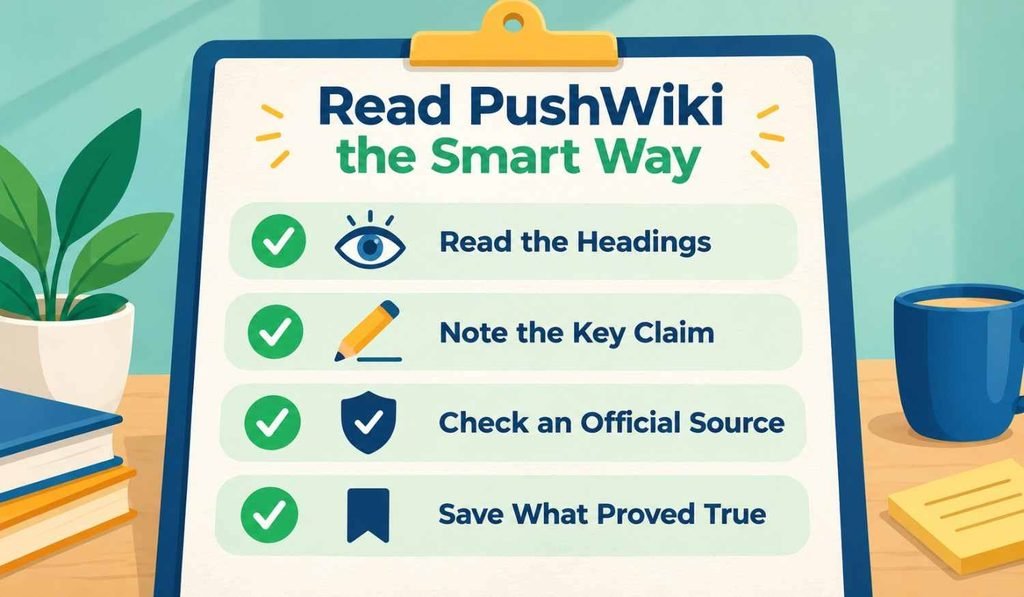
Step four is the one people skip. It takes two minutes and can save you a headache. If a government site or company help page or trusted reference backs up the claim go ahead and use it. If you can’t confirm it hold off.
How to Judge Any Information Site
These checks work on nearly any website. Run through them whenever a new name shows up.
- Does the page name an author or team?
- Is there a clear About page and Contact page?
- Are claims tied to named sources?
- Is the page dated and updated?
- Does the site avoid pushy ads and pop ups?
No site passes every test every time. The overall pattern matters more. A site that clears most of them earns more trust. One that clears few deserves caution. You can run the same list on PushWiki and on any other site in your results.
Common Mistakes People Make
- Assuming anyone can edit it like Wikipedia
- Mixing up the website with the Push programming wiki
- Trusting health or money advice from a single page
- Clicking a lookalike domain with a similar name
The last one is easy to dodge. Type the address yourself or use a bookmark. Skip the random link in a comment or message. That tiny habit blocks most lookalike traps.
The first mistake is about mindset. The word wiki carries weight. It hints at shared knowledge and open review. Remember that a label on a site isn’t proof of how it runs. Look at who publishes and how pages get updated.
Conclusion
PushWiki is a website name and not slang or a texting code. Most of the time it means PushWiki.com. That site offers free and short guides in plain English on technology and AI and business and everyday topics. It isn’t an open wiki. Reviews say only people with special access can add content. A second and older meaning points to a documentation wiki for the Push programming language that started in 2010.
So what should you do with all this? Use PushWiki for a fast first look at a topic. It’s easy to read and free and reported as safe to browse. Then double check any important claim with an official or primary source. That two step habit gives you speed without the risk. And if you came for the programming project make sure the name and context match before you dive in.
FAQs
What is PushWiki?
PushWiki usually means PushWiki.com, a free information website with plain English guides on technology, AI, business and everyday topics.
Is PushWiki legit?
Reviews describe PushWiki.com as legitimate and safe to browse. Still verify important facts with official sources before relying on them.
Is PushWiki a real wiki?
Not in the classic sense. Reviews say only people with special access add content, unlike Wikipedia where almost anyone can edit.
Is PushWiki free to use?
Yes. Reviews say PushWiki.com is free to read and does not require signing up.
Is PushWiki the same as the Push programming wiki?
No. The Push wiki is a separate documentation project for the Push programming language that began in 2010.