

You see a text that says “What’s up, homie?” and then a house listing that calls a cottage “so homey.” The words sound the same. Are they the same word? If you have ever paused with your thumbs over the keyboard, you are not alone. The homey or homie question trips up students, writers, parents, and even seasoned editors.
This guide clears it up in plain language. You will learn what each word means and where each one came from. You will also learn which spelling to use in texts, essays, and captions. By the end you will know when “homie” is the right pick and when “homey” is the one you want.
Homey or Homie?
“Homie” is slang for a close friend. It is short for “homeboy” or “homegirl.” “Homey” is an adjective that means cozy and comfortable, like a home. Dictionaries also list “homey” as a spelling of the slang noun. Still, “homie” is the standard spelling for a friend.
Homey or Homie: The Short Difference
Think of it this way. One word describes a person. The other describes a feeling or a place.
Here is a quick side-by-side look.
- “Homie” is a noun and means a close friend.
- “Homey” is an adjective and means cozy or welcoming.
- “Homie” is slang and fits casual talk and texts.
- “Homey” fits both casual and formal writing when you mean “cozy.”
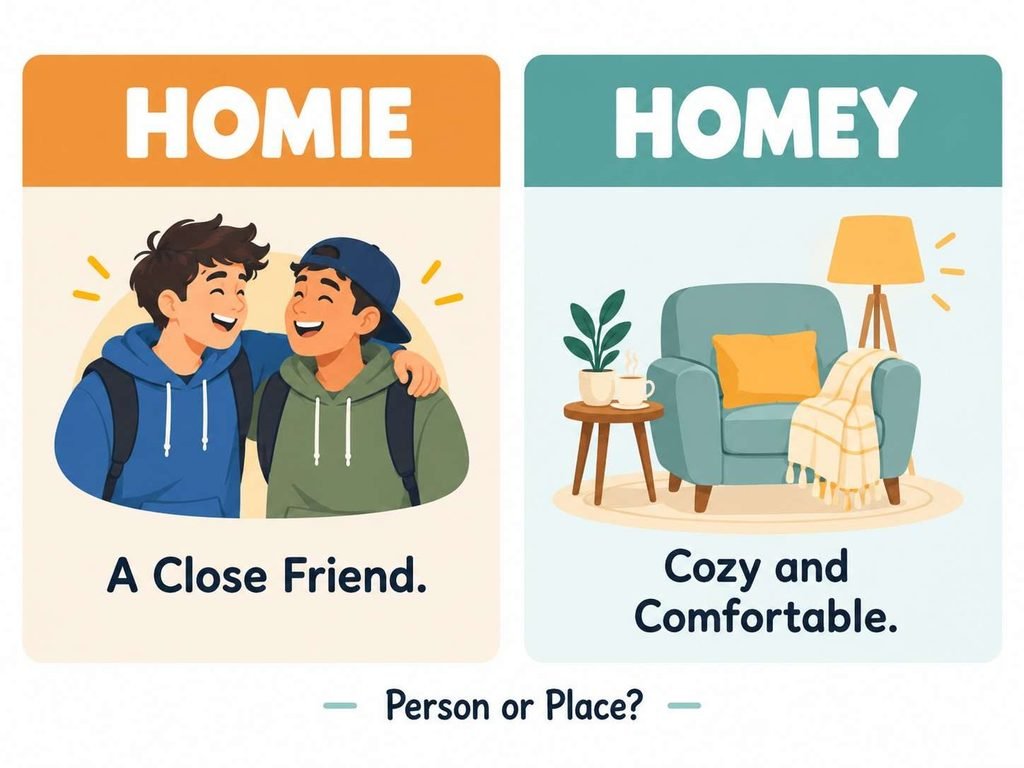
Say you write, “This is my homie Marcus.” You mean Marcus is a close friend. Now say you write, “This café feels so homey.” You mean the café feels warm and welcoming.
Mixing them up can change your meaning. “My homey apartment” is a cozy apartment. “My homie apartment” makes no sense at all. So the first job is to decide whether you are talking about a person or a place.
The confusion exists because both words come from “home.” Both carry the same warm idea of belonging. That shared root is the reason the two words drift so close together in spelling.
What Does “Homie” Mean?
“Homie” is a slang term for a close friend. It can name a friend, as in “This is my homie Russel.” It can also work as a way to address a friend, as in “Hey, homie!” Dictionary.com notes that the word is a shortened form of “homeboy” or “homegirl.” The site also ties these terms to urban and hip hop culture. It says African American and Latinx communities in the U.S. use them most.
The word often points to someone from your own neighborhood. It carries a sense of loyalty. A homie is not just an acquaintance. A homie is someone who has your back.
Homie in Texting and Social Media
In texts the word is warm and casual. People use it the way they use “bro” or “buddy.” You might see it in messages like these.
- “Thanks, homie, I owe you one.”
- “Miss you, homie; let’s hang soon.”
- “My homie just got the job.”
- “Happy birthday to my day one homie.”

It also shows up in captions and comments. A photo of two friends might say “me and my homie.” A reply to a funny post might say, “Facts, homie.”
Tone matters here. Between friends the word feels friendly and relaxed. Used with a stranger or a boss, it can feel odd or too casual. Read the room before you use it.
What Does “Homie” Mean From a Guy or a Girl?
Many people wonder what it means when a guy calls them “homie.” In most cases it means he sees you as a friend. It is a sign of respect and comfort. It is not a romantic signal.
The same goes for a girl who says it. She likely thinks of you as a trusted friend. Some people also use “homie” in a playful way with a partner. Even then the message stays warm and friendly.
If you are unsure about the meaning, look at the context. Look at how the person talks to others. If they call everyone “homie,” it is simply their style.
What Does Homey Mean?
Homey is an adjective. It describes something that feels like home. Dictionary.com defines it as comfortably informal and inviting. Think cozy and relaxed.
You can use it for many places. A living room with a soft couch and a warm lamp is homey. A small inn with a crackling fireplace is homey. A hotel room that feels like your own bedroom is homey too.
You can also use it for smells and moods. Fresh bread makes a kitchen feel homey. A quiet evening with tea can feel homey. Dictionary.com says the word was first recorded in the early 1850s. That makes it much older than the slang term.
Here are some examples of how it works in a sentence.
- The new rug makes the room feel homey.
- Her cabin was small but very homey.
- I love the homey feel of this diner.
- We wanted a homey wedding with close family.
Some dictionaries also list “homy” as another spelling. Both spellings mean the same thing. In American English, “homey” is far more common.
Why the Spelling Gets Mixed Up
Here is where things get messy. Dictionary.com lists “homey” as an alternate spelling of the slang noun “homie.” So if you write “my homey,” a dictionary will not call it an error. The two spellings overlap.
That overlap has a history. The slang noun is fairly new. Writers had a spelling for the adjective long before the slang appeared. When “homie” showed up in speech, people needed a way to write it. Many reached for the familiar “homey” ending. Others chose “homie” to match words like “cutie” and “foodie.”
Over time “homie” won out for the friend meaning. It looks like a nickname. It also keeps the slang word apart from the adjective. That makes reading easier.
Style guides and editors tend to agree on one point. Use “homie” for a friend. Use “homey” for cozy. That rule keeps your writing clear and stops readers from stumbling.
There is one more twist. Dictionary.com also records a British sense of “homey” as an informal word for a British person. That sense is rare today. You will almost never see it in modern writing.
Where Does the Word “Homie” Come From?
The story of “homie” is a story of shortening. Reference sources trace it back to “homeboy.” That word meant a male friend from back home. Many etymologists link it to Mexican American Spanglish from the late 1800s. In that era more Latino families moved into growing cities. A homeboy was someone from your old town or your block.
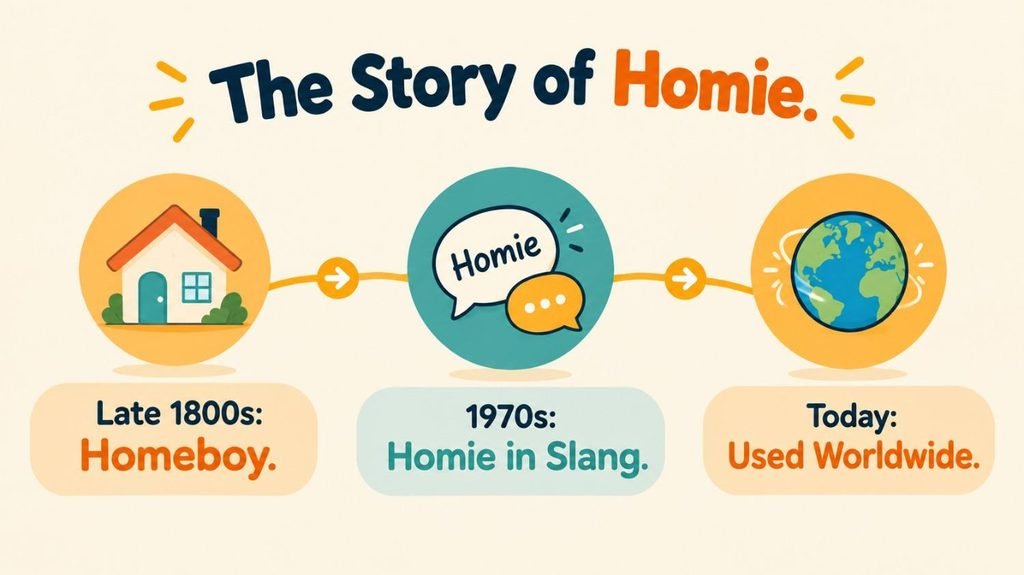
Over the years the word was clipped to “homie.” Slang sources place it firmly in use by the 1970s. Dictionary.com records the slang noun form of “homey” as first appearing in the early 1990s. That tells you how gradually the term moved into wider print.
There is also an older and separate use. Slang references note that an identical word appeared in New Zealand in the 1920s. It described a recently arrived British immigrant. That meaning has nothing to do with friendship. It shows that the same sound can grow from different roots.
Hip hop then carried the word to a global audience. Artists in Los Angeles and other cities used “homie” in songs and interviews. Films and television pushed it further. By the 1990s people far from any city block were saying it. Today it shows up in memes and group chats around the world.
The word also has a link to community. In many neighborhoods a homie was part of your crew. It signaled trust and shared roots. Even now that sense of belonging sits under the casual use.
How to Use Homie and Homey in Real Life
Getting the words right is easier with a few clear examples. Here are lines you can copy for different situations.
Using homie:
- Send a thank you text to a friend who helped you.
- Introduce a close pal at a party.
- Write a caption for a photo with your best friend.
- Greet a friend with a quick “What’s up, homie?”
Using homey:
- Describe a cozy home in a listing.
- Review a restaurant that feels warm and welcoming.
- Talk about decor that makes a room feel comfortable.
- Praise a hotel that feels like home.
Notice the pattern. Homie goes with people. Homey goes with places and feelings.
A few tips can help you decide in the moment.
- Ask if you mean a person or a place.
- If you mean a friend, write homie.
- If you mean cozy, write homey.
- When in doubt, replace the word with “friend” or “cozy.”
That last tip works like a test. If “friend” fits the sentence, you want homie. If “cozy” fits, you want homey. The test takes two seconds, and it rarely fails.
Regional and Generational Differences
Words shift by place and by age. Homie is no exception.
In the United States the word is common in casual speech. You hear it in big cities and small towns alike. Younger people use it most. Yet many older adults know it from music and films.
In the United Kingdom the picture is different. The word “homie” is understood but less common in daily talk. British speakers often reach for “mate” or “pal” instead. Some also use “homey” for cozy, far less than Americans do.
The adjective side has its own twist. The podcast A Way With Words points out that “homely” means cozy in the UK. In the US the same word usually means plain or unattractive. So an American might say “homey,” while a Brit says “homely.” That is a handy fact if you write for readers on both sides of the Atlantic.
Age matters too. Gen Z and younger millennials use “homie” as a warm and playful label. Some older speakers still link it to street culture and hold a narrower view. Others treat it as just another friendly nickname. Neither reading is wrong. It depends on who is talking and who is listening.
There is also a note on respect. Because the word grew from African American and Latinx communities, some people feel it belongs to those roots. Using it with care and warmth is fine. Using it to mock or imitate a culture is not. Tone and intent shape how the word lands.
Common Mistakes to Avoid
People trip on these words in a few predictable ways. Watch for these slips.
- Writing “homie” when you mean cozy.
- Using “homey” for a friend in formal writing.
- Calling every stranger “homie” in a work setting.
- Mixing up “homely” with “homey” in American English.
Let us look at each one.
The first mistake is common in home decor writing. A blogger might describe a “homie kitchen.” That reads as a typo. The right word is “homey.”
The second mistake is subtle. Since dictionaries allow “homey” for a friend the choice is not a true error. Still it can confuse readers. Pick “homie” for friends and your text stays clean.
The third mistake is about tone. Slang works best between people who know each other. In an email to a client “homie” can feel careless. Save it for casual chats.
The fourth mistake is about a false friend between dialects. If you tell an American that their house looks “homely” you may offend them. Say “homey” or “cozy” instead.
Related Words You Might See
Several other words sit near these two. Knowing them helps you read slang with more confidence.
- Homeboy and homegirl are the longer forms of homie.
- Homely means cozy in the UK and plain in the US.
- Homy is a rarer spelling of homey.
- Homeyness and hominess are the noun forms of homey.
- Fam and bestie are other casual words for close friends.
Each one has its own feel. “Homeboy” and “homegirl” sound a bit more traditional. “Bestie” sounds lighter and more playful. “Fam” suggests a tight group.
Slang also changes fast. A word that feels fresh this year may sound dated in five. Homie has lasted for decades though. That staying power says a lot about how well it fills a gap. English needed a warm word for a friend who feels like family.
A Simple Memory Trick
Want a way to lock this in? Try this small trick.
Homie is about who is with you. Homey is about how a space feels. If you can hug it, you likely mean a homie. If you can sink into it, you likely mean homey.
Say the words out loud with an example each time. “My homie helped me move.” “My new place feels so homey.” After a few tries the choice becomes automatic.
Why This Small Word Matters
Words like these show how language grows. Everyday people shape English every day. They shorten words and swap endings. They turn a phrase about a neighborhood into a word for friendship.
The homey or homie question also shows why context is king. Two words can sound the same and mean very different things. A reader relies on you to pick the one that fits. When you do, your message lands cleanly. When you do not, the reader stops and wonders what you meant.
Good writers care about that pause. They choose the spelling that keeps the reader moving. Now you can do the same.
Conclusion
The homey or homie puzzle comes down to one simple split. Homie is a slang noun for a close friend. Homey is an adjective for anything cozy and welcoming. Keep them apart and your writing stays clear.
Remember the history too. Homie grew from “homeboy” and rose through American neighborhoods and hip hop. Homey is older and simply means feels like home. Dictionaries do allow “homey” as another spelling for the friend sense. Still the cleanest choice is “homie” for people and “homey” for places.
Next time you type one of these words run the quick test. Ask if “friend” or “cozy” fits better. Use your answer to pick the word. That one habit will save you from most mistakes.
FAQs
Is it homey or homie for a friend?
Homie is the standard spelling for a close friend. Dictionaries also accept homey, but homie is clearer and far more common in modern writing.
What does homey mean?
Homey means cozy, comfortable and welcoming, like home. People use it for rooms, cafes, hotels and moods. It can also be a variant spelling of the slang word homie.
What does homie mean in a text?
In a text homie means a close friend. It is a casual and friendly way to address someone you trust, like buddy or pal.
Is homie a compliment?
Yes. Calling someone your homie shows trust and closeness. Tone matters though. Between friends it feels warm, but with strangers or in formal settings it may sound too casual.
Where did the word homie come from?
Homie is short for homeboy or homegirl. The terms grew from Mexican American Spanglish and American urban culture. Hip hop later spread the word around the world.