
Picture this. You’re typing a quick note to a client, something like “your payment has been transferred,” and your cursor freezes. Does that look right? Plenty of confident writers stall on exactly this word, and it’s no surprise, because the question of “transferred” or “transfered” trips up students, managers, and bank staff alike.
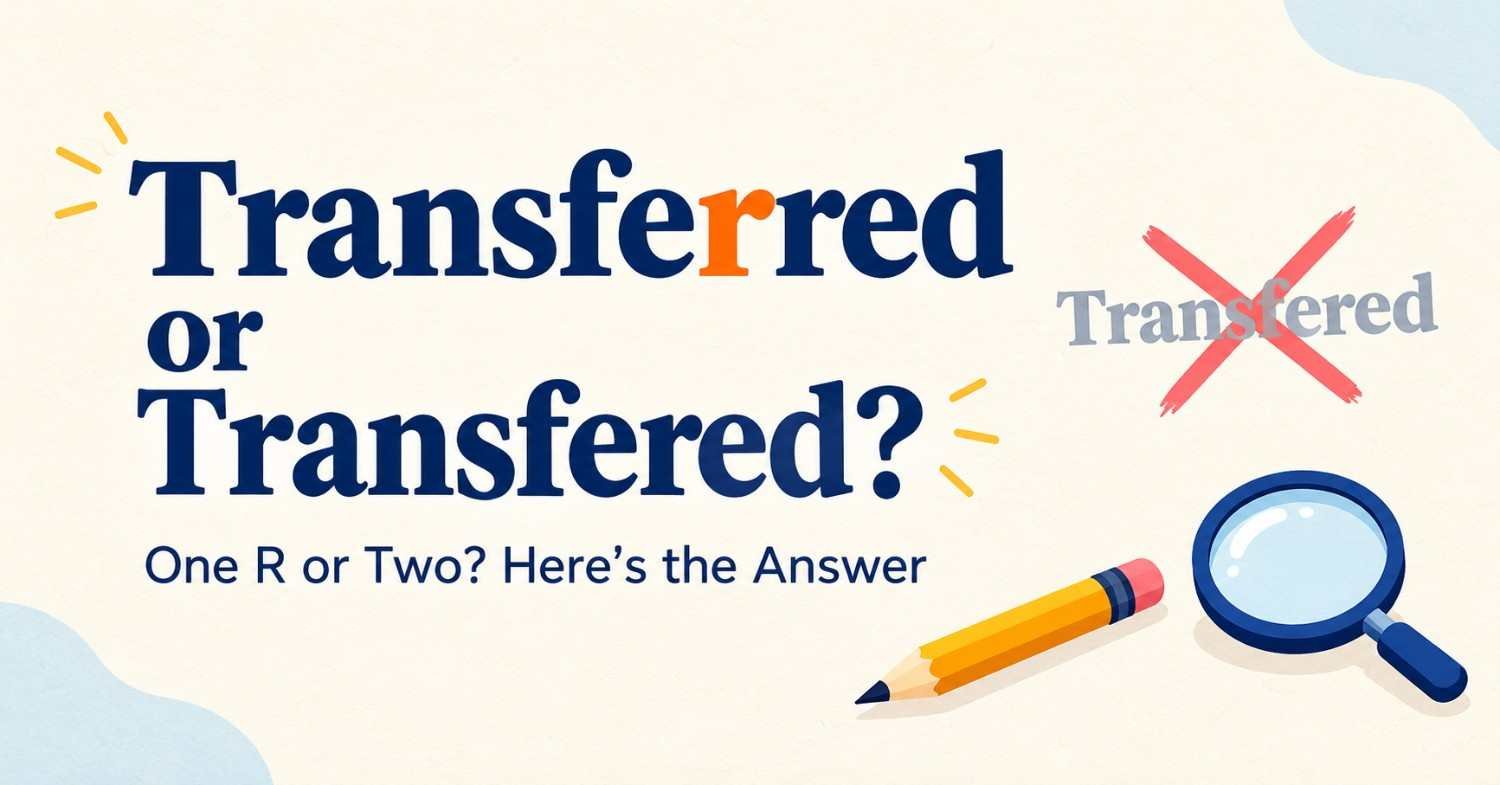
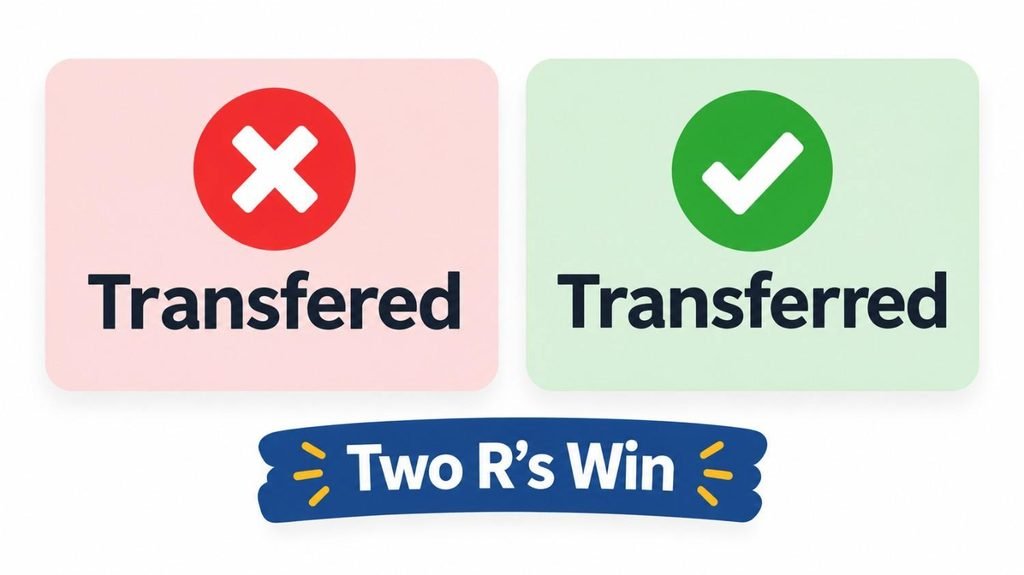
Here’s the straight answer. Transferred, with two r’s, is the correct spelling. Transfered, with one r, is a misspelling in American English, British English, and every other major variety. No region accepts it.
What makes the topic worth a full guide is the reason behind that extra letter. It isn’t random. It follows a grammar pattern that quietly controls the spelling of hundreds of other verbs. Once you see the pattern, you’ll stop guessing.
Below you’ll find the transferred meaning in plain terms, handy synonyms, the doubling rule, a look at UK and US habits, plenty of examples, and a few tricks for proofreading. Let’s get into it.
Transferred or Transferred: The Short Answer
Which Spelling Is Right?
Transferred is right. It’s the past tense and the past participle of the verb transfer, and the big references agree. You can look up the entry for “transfer” at Merriam-Webster or the one at Cambridge Dictionary, and you won’t find “transferred” listed as a valid form anywhere.
Try two sentences. She transferred to the Boston branch last June. The money was transferred before noon. Both read cleanly. Now picture the same lines with a single r, and you can see why editors circle them in red.
Transfered or Transferred in English: Why the Mistake Keeps Happening
Most English verbs take a -ed ending. Walk becomes walked, open becomes opened, and nobody thinks twice. So when a writer meets transfer, the brain runs the usual script and produces transfer. It feels logical.
Speech makes things worse. Say the word out loud, and you can’t really hear the second r. Nothing in the sound warns you to double it. The rule lives in the spelling, not in your ears, which is why even careful typists slip.
Autocorrect adds another wrinkle. On a phone, a rushed thumb can skip a letter, and the software doesn’t always rescue you. That’s how a misspelled word ends up in a text to your landlord.
A Memory Trick That Actually Sticks
Think of it this way: a transfer carries something across, and the word needs a second r to make the trip into the past. Silly, sure. But a mental picture beats a rule you have to look up. Some people pair it with “referred” and “preferred,” two words they already spell without effort. If those feel natural, transferred will too.
Transfered or Transferred Meaning and Definitions
Transferred Meaning as a Verb
To transfer means to move someone or something from one place, person, group, or situation to another. “Transferred” is simply that action finished. A hospital transfers a patient to a different ward. A seller transfers a deed to the buyer. You transfer a call to billing, a photo to your laptop, and a balance to a new card. A worker transfers to another office, and a student transfers to a new school.
Different settings, same core idea. Something changes location, holder, or status.
Adjective Use and Transferred Meaning in Language Studies
“Transferred” also works as an adjective. Think of a transferred employee, a transferred call, or transferred credits on a college record.
Language teachers use the phrase transferred meaning in a slightly different way. There it points to a figurative sense that grew out of a literal one. A bottleneck started as the narrow neck of a bottle, yet today we say it about traffic jams and slow approvals. A close cousin is the transferred epithet, where an adjective that belongs to a person gets pinned on a nearby noun. A sleepless night is the classic case. The knight isn’t awake. The person is.
All of these uses share one root idea: carrying something across from one thing to another.
Transfered or Transferred Synonym Choices
Variety helps your writing breathe. The right synonym depends on the setting, so here’s a quick guide.
| Setting | Synonym options | Example sentence |
|---|---|---|
| General movement | moved, shifted, relocated | The team was relocated to Austin. |
| Money | sent, wired, remitted, deposited | He wired the funds on Friday. |
| Ownership | conveyed, assigned, signed over | The title was conveyed to the buyer. |
| Work or school | reassigned, redeployed, switched | She was reassigned to marketing. |
| Data | copied, moved, migrated, uploaded | The records were migrated to a new system. |
| Responsibility | handed over, passed on, delegated | Duties were handed over to a colleague. |
“Wired” fits a bank payment, “reassigned” fits a job change, and “transferred” is the safest all-purpose word when you’re not sure which word to use.
Transfered or Transferred Grammar: The Doubling Rule
How the Stress Rule Works
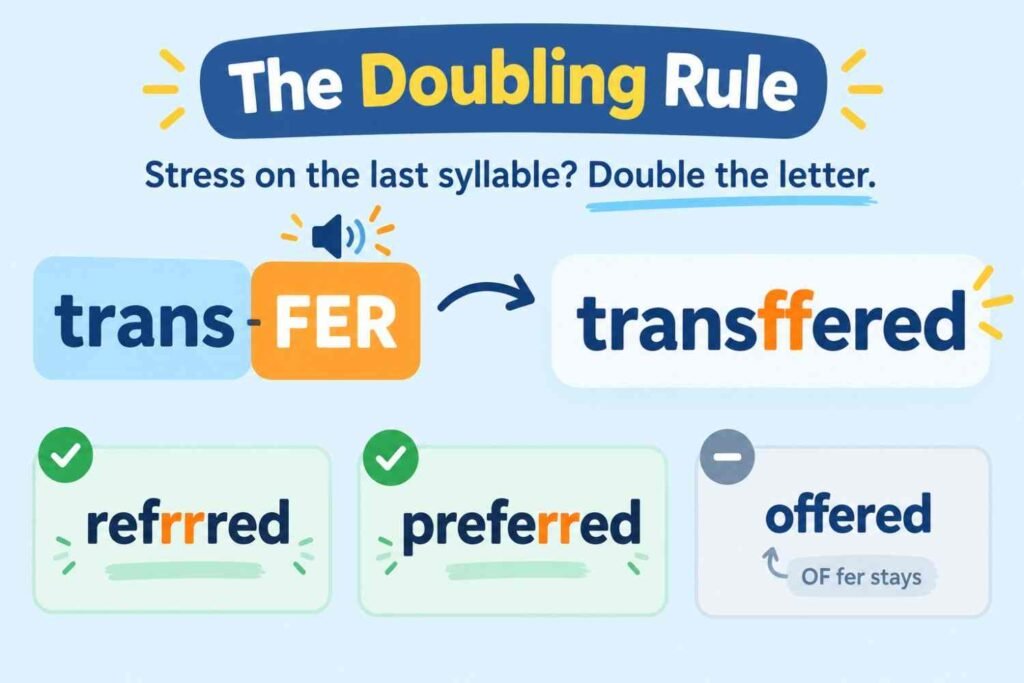
Here’s the part many guides skip. Why does the “r” double? English follows a pattern. If a verb ends in one vowel plus one consonant, and the stress lands on the last syllable, you double that final consonant before adding ed or ing.
Take a transfer. As a verb, you say “transfer,” with the punch on the second syllable. It ends in the vowel e and the consonant r. So the r doubles, and you get transferred and transferred.
The same logic shapes many familiar words: referred, preferred, deferred, conferred, inferred, occurred, admitted, and committed. Spell those without effort? Then you already know the rule, whether you realized it or not.
Why Offered and Suffered Stay Single
Compare some lookalikes. The offer is said to be OF fer, with stress up front. Suffer is SUF fer. Differ is DIF for. Enter is EN ter. Since the stress isn’t on the last syllable, the final consonant stays single, giving offered, suffered, differed, and entered.
So the whole secret fits in one sentence. Stress on the last syllable means double the letter, and stress anywhere else means leave it alone. Transfer as a verb stresses its last syllable. The offer doesn’t. That’s the entire difference.
Transferable, Transference, and Their Cousins
Stress can move when a word grows a new ending, and the spelling moves with it.
| Word | Where the stress falls | Spelling note |
|---|---|---|
| transferred | transferred | Double “r” in the past tense. |
| transferring | trans-FER ring | Double r before ing. |
| transferable | trans FER a ble, or TRANS fer a ble | Single r is standard, and transferrable is an accepted variant. |
| transference | Transference | Single because the stress moved forward |
| transfer | trans FER al | Single |
| transferor and transferee | trans FER or trans FER EE | Single “r,” common in legal writing |
For the past tense, there’s no debate at all. It’s transferred every time. For derived forms like “transferable,” a quick dictionary check is a smart habit.
Transferred or Transferred UK vs. US Spelling
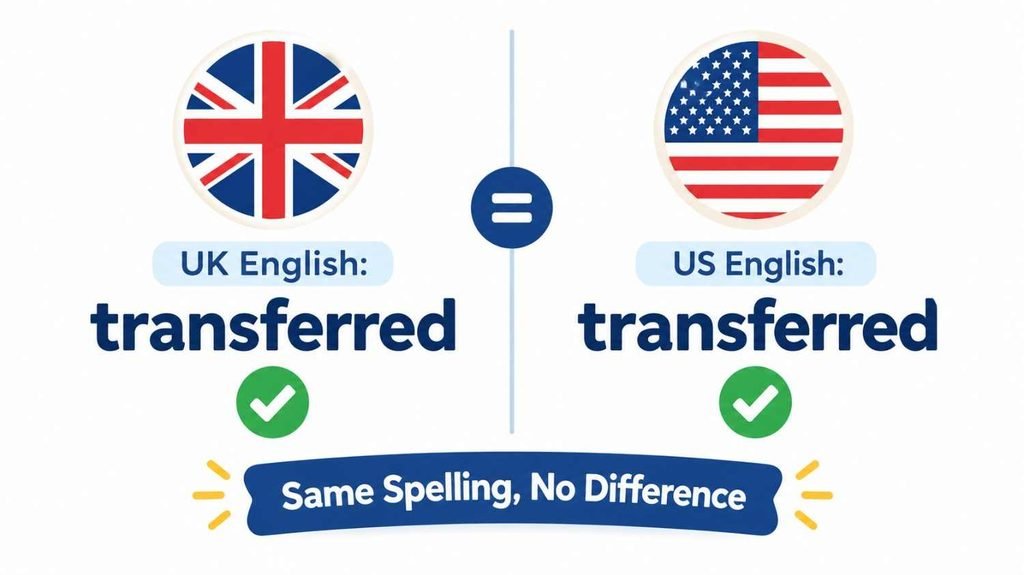
Transferred or Transferred UK: No Difference
People often search for “transferred” or “transfered” in the UK because they suspect British spelling plays by other rules. It doesn’t, at least not for this word. British English uses “transferred,” just like American, Canadian, Australian, and Indian English. “Transfered” isn’t a regional variant anywhere. If your readers span several countries, you never have to switch spellings. The Oxford Learner’s Dictionaries entry gives you proof from a British publisher.
Where British and American Spelling Really Split
The genuine differences show up with verbs whose stress isn’t on the last syllable. British writers tend to double the final l anyway, while Americans follow the stress rule more closely.
| Verb | US spelling | UK spelling |
|---|---|---|
| travel | traveled | travelled |
| cancel | canceled | cancelled |
| model | modeled | modelled |
| label | labeled | labelled |
| transfer | transferred | transferred |
Notice the last row. Transfer already follows the stress rule, so both varieties land on the same spelling. Americans do sometimes write “cancelled” too, but “canceled” is the usual form.
What Style Guides Say
Professional style guides follow standard dictionary spelling, and that means transferred. The Chicago Manual of Style and the AP Stylebook both work from that base, and British publishers using Oxford conventions do the same. If an editor hands you a style sheet, this word won’t need changing.
Transfered or Transferred Examples in Real Life
Transferred Money and Banking
Money writing is where this typo hurts most, because accuracy signals trust. Nobody wants to wonder whether a bank that can’t spell can handle a balance. Correct sentences look like this. I transferred $1,000 from checking to savings. The funds were transferred by wire on Monday. She transferred the balance to a card with a lower rate.
Prepositions matter too. With transferred money you’ll usually see “to” for the destination, “from” for the source, and “into” for an account type, as in “transferred into an IRA. “If you want to understand your rights around electronic payments, the Consumer Financial Protection Bureau publishes plain language guides.
Jobs, Schools, and Hospitals
After two years in Chicago, he was transferred to the Seattle office. Her credits transferred smoothly from community college. The call was transferred to the billing team. The patient was transferred to intensive care.
Notice that the word works as an active verb, as in “she transferred,” and as a passive one, as in “was transferred.”
Tech and Data
The files were transferred over the network. Your photos have been transferred to the new phone. The domain was transferred to a different registrar.
In product copy, consistency matters. If a button reads “Transfer complete,” the help article should say “transferred,” not “transferreded.” Small details like that make a brand look careful. Dictionary.com has a full entry if you want more usage samples.
Proofreading Tips So You Never Slip Again
Why Spell Check Misses It
Most word processors underline transfered in red. The trouble starts where there’s no safety net: social posts, tiny text boxes inside apps, slide decks, and screenshots. Autocorrect can also swap a word for something you never meant. Anything involving money, contracts, or customers deserves a slow second read.
Fast Self Checks
Say the word in beats and hear the stress land on the end: trans FERRED. Compare it with a sister word you trust, like referred. Run a find and replace for transfered before you publish a long document. And if you edit for a team, add the word to your style sheet so nobody argues about it twice.
A Four Step Checklist
- Does the word end in a stressed syllable with one vowel plus one consonant? Then double the consonant.
- Are you adding ed or ing? Then the doubling rule applies.
- Is the word transfer? Write transferred or transferring.
- Is it a derived form such as transferable or transference? Check a dictionary.
Frequently Asked Questions
Is it transferred or transfered?
Transferred is correct. Transfered is a common misspelling. The last syllable of transfer carries the stress, so the r doubles before ed.
What is the meaning of transferred?
Transferred means moved from one place, person, or account to another. It covers money, property, jobs, students, patients, and data.
Is transferred spelled differently in the UK?
No. British and American English both write transferred with two r’s.
What is a synonym for transferred?
Moved, relocated, reassigned, conveyed, sent, or wired, depending on the context.
Why does transferred have two r’s?
English doubles a final consonant when the last syllable is stressed and ends in one vowel plus one consonant, as in referred and preferred.